
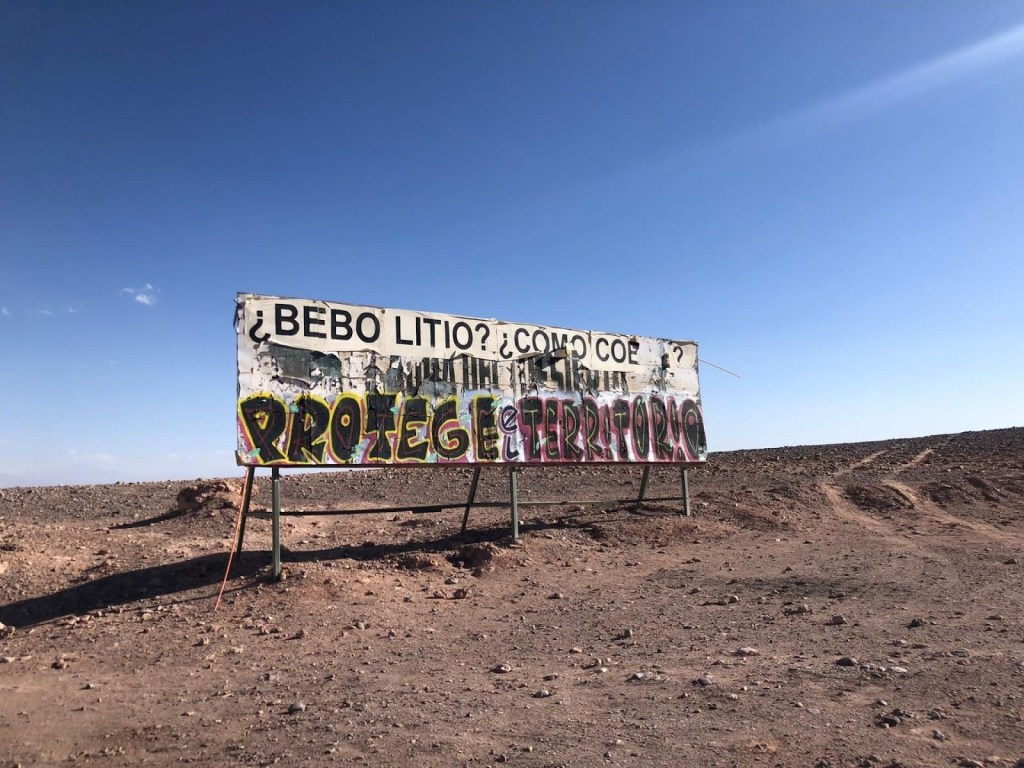
“Do I drink lithium? Do I eat copper? // Protect the territory”. Protest poster against extractivism in San Pedro de Atacama, Chile. Photo Credit: Marina Otero
2nd December 2025
A rights-based approach to energy can extend access, but also risk legitimising an extractivist status quo.
For years, the idea of an energy transition has been sold as a technical fix. The language is full of targets and promises of efficiency. That kind of language makes it seem like the problem is too much carbon, too little innovation. But beneath lies a political question that rarely gets asked, that is, who gets to control it, and what kind of world it sustains?
Much of what passes for transition continues to reproduce the logic of extractivism under a new label. The technologies change, the geography doesn’t. Where once regions were drilled for fuel, they are now mined for lithium and cobalt (in some cases, the exact same places). In Morocco, for example, residents compared the 2011 protests around a new solar complex with long-running conflicts over the nearby Bou Azzer cobalt and silver mines.
In places all over the world territories are being re-engineered in the name of decarbonisation, often without the consent of those who live there. A recent Oxfam report shows how the bulk of critical minerals for renewables lie in the Global South while economic gains concentrate in distant markets, producing new green sacrifice zones, areas where destruction is justified by promises of sustainability delivered to someone else.
Evidence of these sacrifice zones abounds. Cobalt mining in the DR Congo has created one of the planet’s most polluted regions, with extensive human rights violations and health crises. Nickel smelting in Indonesia has caused deforestation and deadly floods. Lithium extraction in South America’s so-called lithium triangle (formed by salt flats in Argentina, Bolivia and Chile) is draining water from Indigenous farmers. Even in Europe, plans to mine lithium in Serbia or copper and nickel in indigenous Sámi territory gave rise to fierce local resistance.
For these communities, the argument is rarely about opposing energy production itself. It’s about who decides how that energy is produced and who pays the price for it. Seeing energy only as an abstract physical magnitude helps disconnect it from these issues. In colonial and postcolonial contexts, that abstraction served to legitimise appropriation. Turning a river into a megastructure or a mountain into a quarry can be justified as resource optimisation as long as efficiency remains the guiding principle.
In that sense, the problem isn’t only that energy systems can be exploitative. It’s that they define what energy is in ways that make exploitation appear rational. A dam can flood a valley and still be called progress, because the river’s new function (i.e generating power) fits the official metric of efficiency. What disappears from view are the other functions that the river held, be it cultural/spiritual or ecological. Those cannot be priced, so they vanish from the calculation.
In this context, the idea of a human right to (sustainable) energy has gained traction in recent years as a seemingly progressive way to address its unequal access. On paper it sounds great – everyone should have access to reliable, affordable electricity. The logic fits easily into national and international frameworks. Yet framed in this universalist language, the right reproduces the same assumptions that sustain the current status quo. It treats energy as a neutral, context-free good whose provision can be standardised and scaled, masking the histories of dispossession that made modern energy systems possible.
By translating collective territorial struggles into an individualised legal entitlement, the framework tends to centralise control in the hands of those that implement energy policy, who become the primary providers and arbiters. Rather than questioning the extractivist logics that turn communities and ecosystems into sacrifice zones, a human right to energy can end up legitimising their continued transformation as long as it is done in the name of access and sustainability.
Even progressive governments will struggle to escape the dynamics. Their administrative reforms may soften certain inequalities but reinforce others (e.g. extractive policies, global market integration).
That doesn’t mean this legal approach has no value. In contexts where people live without power, a rights framework can force investment or prevent disconnections. The issue is that when rights become the only language of struggle, the political horizon narrows to administration.
What’s emerging instead, often below the radar of national planning, are experiments in autonomy. In Europe alone, an estimated 23,000 community energy projects involving around two million people were active as of 2020-21. These experiments force us to reconsider what “transition” even means. In the dominant narrative, transition is a linear movement from dirty to clean. But the experience of many communities suggests another reading: transition as struggle, as the reorganisation of life around different priorities.
Thinking in those terms changes the role of knowledge. Instead of importing models from ministries or consultants, communities build their own criteria for sustainability. They define what “enough” looks like and what kind of impact is acceptable. These criteria often include factors invisible to standard metrics like cultural continuity and social cohesion. In that sense, local autonomy doesn’t reject science but it places it in dialogue with other forms of knowledge.
The idea of a right to energy can be reimagined along those lines, as the collective capacity to decide how energy is produced and used within a territory. This concept is similar to the older idea of a “right to the city,” which links urban justice to control over the conditions of dwelling. Territorialising energy follows the same logic. It means understanding energy as a relation to be governed collectively.
This shift also calls for a reassessment of rights discourse itself. The language of human rights assumes a universal subject, abstracted from history and geography. It can protect, but it can also homogenise. A pluriverse of practices gets forced into a single frame. The challenge is to create legal architectures that recognise heterogeneity, to make it ‘porous’ enough to accommodate multiple ways of living with energy.
All this points to a broader conclusion, that the transition’s core dispute is not technological but political. If decision-making remains concentrated, the system will reproduce its old hierarchy through new means. The promise of clean energy will become another story of dispossession.
If justice is to mean anything in the energy transition, it must start from the ground up. Territorialising the right to energy means accepting that it cannot be standardised. It’s built through collective experimentation, through the capacity to decide how to inhabit the world together. That form of politics may be messier than a policy rollout, but it’s also the only one capable of transforming the foundations of the system it seeks to replace.
Written by Kevin Picado
 The WCCA