
The institutions behind “national security” efforts are structurally implicated in accelerating planetary instability, while simultaneously positioning themselves as managers of the chaos that will follow.
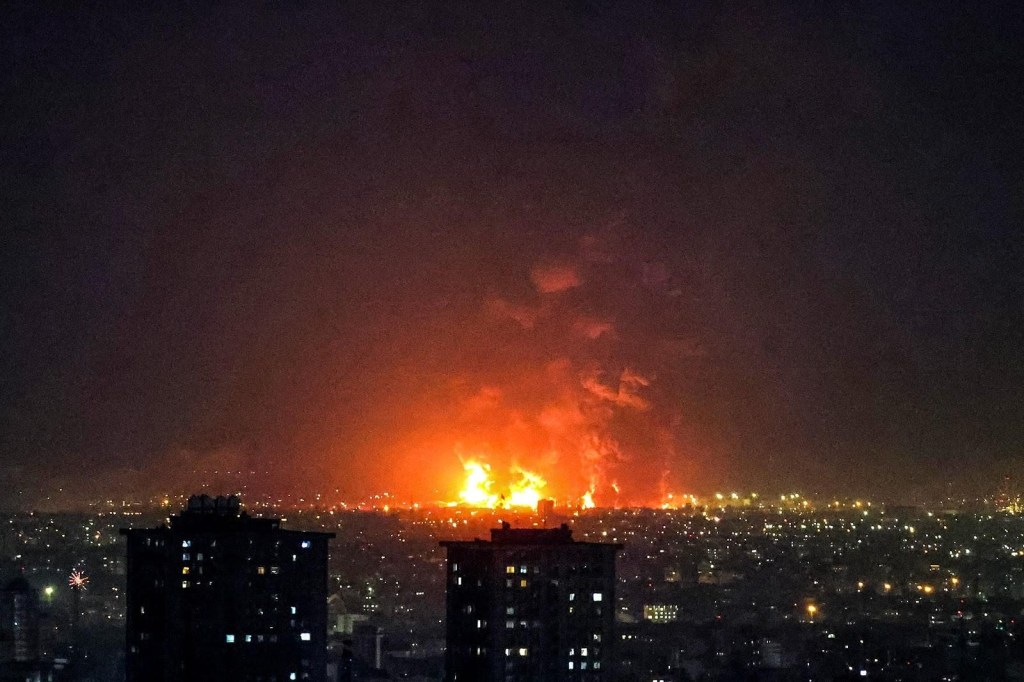
Explosions erupt following Israeli strikes at Tehran Oil Refinery on March 7, 2026. Source: Atta Kenare / AFP
13th March 2026
As bombs fall on Iran and Lebanon, a new consensus is forming on the acceleration of global warming. These events are not isolated tragedies, they are symptoms of the same cancer afflicting the planet. The machinery of war that devastates cities and displaces millions is sustained by the same political and economic structures that drive ecological breakdown, directing immense resources toward the killing of innocents while the planetary systems that sustain life collapse around us.
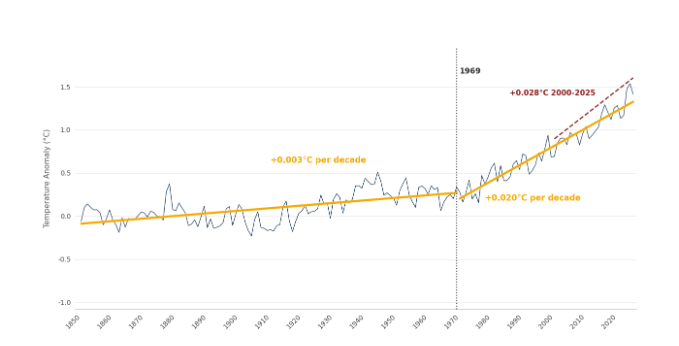
On average, temperatures have been rising by 0.020°C each decade since 1970, that’s around seven times faster than the earlier period. Data taken from OWID adapted from HadCRUT5.
The largest institutional emitter of greenhouse gases on Earth is the United States Department of Defence. Estimates from the Costs of War project indicate that between 2001 and 2017 US military operations emitted roughly 1.2 billion tonnes of carbon dioxide, with a substantial share generated outside US territory in wars such as Iraq and Afghanistan. A 2022 report calculated that global military activity accounts for approximately 5.5 percent of total greenhouse gas emissions, a proportion greater than that produced by all commercial aviation and shipping combined.
These figures are conservative estimations, because of a lack of transparency surrounding data. During negotiations that led to the Kyoto Protocol in 1997, the United States successfully pressed for military emissions to be exempt from reporting requirements, citing strategic concerns. The 2015 Paris Agreement removed the formal exemption but made reporting voluntary. In 2021 NATO announced it would develop its own methodology to measure emissions, but all the data will remain internal. Most states do not disaggregate or publish meaningful data on military emissions, and defence industries face no binding obligation to disclose their climate footprint. Laws frequently carve out exceptions for activities deemed essential to defence and public security. For example, in the EU, defense is considered an exclusive competence of member states and is automatically excluded from many EU-wide environmental regulations. Even the new EU Carbon Border Adjustment Mechanism includes military-related exemptions that could allow carbon-intensive defense imports to bypass the tax.
The environmental cost of militarism extends well beyond fuel burned in combat or training. A full life-cycle assessment is needed to account for extraction of raw materials, processing, manufacturing of weapons systems, maintenance of bases, logistical supply chains and eventual disposal of equipment and munitions. Research within the European and British contexts indicates that arms production and procurement chains make up the majority of military emissions.
Nevertheless, direct fuel consumption remains immense. A single Leopard 2 tank can consume up to 530 litres of fuel per hundred kilometres. An advanced fighter aircraft like the F-22 Raptor burns between 4,000 and 5,900 litres of fuel per hour of flight, with operating cost per hour measured in tens of thousands of dollars.
Military land use introduces further pressures. Training grounds and defence estates are estimated to cover between one and six percent of global land surface. Military exercises increase wildfire risk, disturb soils and reduce the capacity of ecosystems to capture and store carbon – even more so during periods of military warfare, all of which is linked to sharp declines in wildlife. Waste disposal practices have historically included open-air burn pits and detonation of surplus munitions, releasing toxic compounds into the air, soil and groundwater. Forever chemicals have been detected near hundreds of military bases, affecting drinking water and public health. Bombing exercises have been associated with the appearance of birth defects in the nearby population.
War magnifies every dimension of environmental harm. Bombardment disperses heavy metals and toxic residues, and armoured vehicles like tanks compact soils and destroy vegetation. Explosions ignite fires that release additional greenhouse gases. In some cases environmental destruction is deliberate, as in the chemical defoliation campaigns carried out by the United States during the Vietnam War, or the ecocidal actions of Israel in Palestine. Nuclear weapons testing has left legacies of radioactive contamination across multiple regions. The use of depleted uranium munitions (widely used since the Gulf War in 1991) disperses radioactive particles upon impact.
War-induced environmental destruction extends to the reconstruction of areas after conflict, which requires energy-intensive cement and steel, embedding further emissions in the rebuilding process.
These material effects are inseparable from the political economy that sustains them. A small group of countries dominates global arms exports and accounts for the overwhelming majority of military expenditure, while remaining responsible for a disproportionate share of global greenhouse gas emissions. The defence sector protects and depends on a model of accumulation built on extraction of fossil fuels, critical minerals, water and agricultural land. As resource scarcity intensifies under conditions of climate stress, access to these inputs is increasingly framed as a matter of national security, and the prospect of achieving Environmental Justice appears to be little more than a pipe dream.
Written by Kevin Picado
 The WCCA