
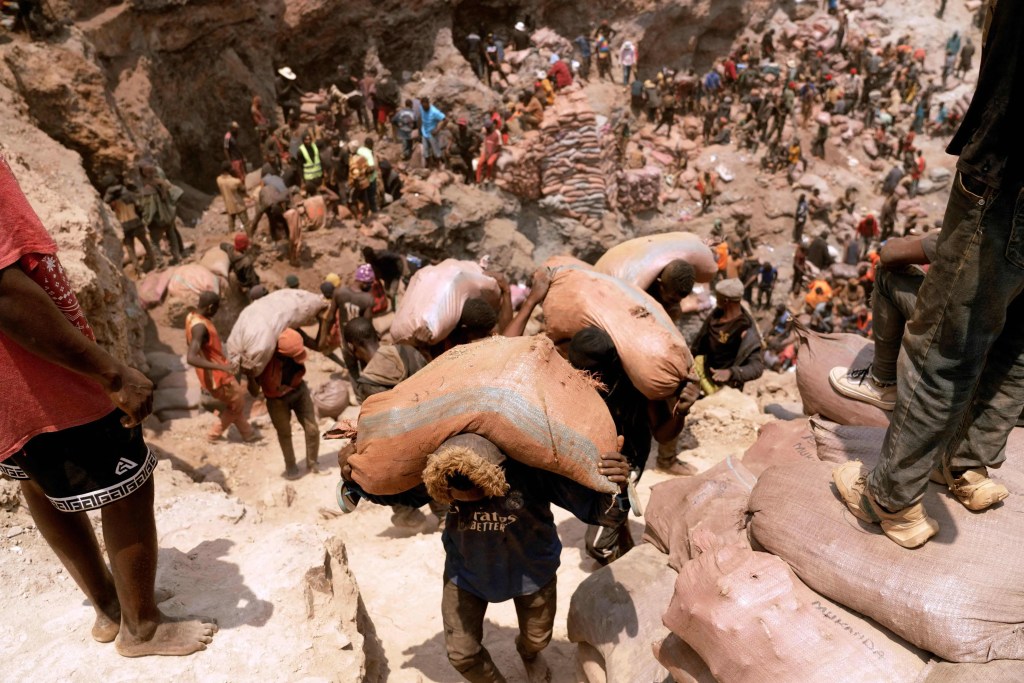
Cobalt miners at the Shabara mine in the Democratic Republic of the Congo.
Photo Credit: Junior Kannah
29th October 2025
Capitalism has never operated evenly across space. It has always organised the world into zones of extraction and zones of command. At one end, territories are devoted to removing resources from the earth. At the other, knowledge is produced and protected as private property. Between them flows a steady but unequal stream of value.
In much of the global South, the economy has long revolved around supplying the rest of the world with raw materials. From (neo)colonial[1] mining to industrial agriculture, the region’s development has been shaped by a pattern of dependence that has outlasted ideological shifts and changes of government. Political programs have varied, but the material base has remained the same.
Extraction is more than digging or harvesting. It is a large-scale removal of natural resources with minimal transformation. Mining and monoculture farming are the most visible forms, but their reach extends into new technologies and techniques that reorganise how land and energy are used. Globalisation has not displaced these processes (ongoing since colonial times). It has integrated them into a wider system. Extraction has adapted to the current stage of accumulation, remaining essential to it, resulting in what some describe as accumulation by dispossession, where nature itself is turned into a commodity and its exhaustion is reframed as growth.
While the South continues to provide the material base of production, the North consolidates control over the immaterial. Its economies are organised around knowledge, and its power is secured through legal systems that protect intellectual property. Patents and trademarks have become the instruments of this new phase. They turn ideas into exclusive assets. The commodification of knowledge extends the logic of the market into domains once considered commons. A market for intangibles now runs parallel to the market for raw materials and foodstuffs, and both feed into each other.
This transformation marks a broader transition within capitalism. Where the industrial era relied on labour to generate knowledge, the present one relies on the ownership of knowledge to generate value. Production continues, but what gives commodities their worth increasingly lies beyond the material. Control over innovation, information, and design determines who captures the surplus. Value no longer comes from the physical transformation of matter alone, but from the legal and institutional control of immaterial flows. Knowledge has become a new terrain of property.
This stage has been described by some as cognitive capitalism, a form in which the capacities of mind and relation are themselves sources of profit. The key to accumulation lies not in the factory but in the ability to regulate access to ideas and technologies. Ownership extends to the realm of thought and technique. This control creates rents rather than wages, producing income from permission rather than production.
In the global South, the extractive and cognitive dimensions are now intertwined. Take for example the expansion of agriculture, which depends on patented seeds and agrochemicals owned by multinational corporations based in the global North. Farmers pay not only for physical inputs but also for the right to use proprietary technologies. Through these payments, resources flow northward in financial form, complementing the flow of resources. The South exports foodstuffs while the North captures intellectual rents.
The relationship is functional for both sides but unequal in effect. The South remains dependent on commodity markets whose prices fluctuate beyond its control. The North deepens its dominance through control of innovation and legal regimes that enforce it. Institutions like the World Trade Organisation provide the framework for this asymmetry, standardising intellectual property rules and ensuring their global reach. The result is a world where access to knowledge, and the profits derived from it, are concentrated in a few centres while the rest provide the biological and mineral substrate of the system.
This asymmetry also defines the global metabolism of capitalism, in other words, the way societies appropriate, transform, and discard matter and energy. The metabolic profile of an extractive economy is marked by high material throughput [2] and low capacity for regeneration. But the consequences are unevenly distributed. The cognitive economies of the North externalise their ecological costs, importing raw materials and exporting pollution in disguised form. The apparent cleanliness of high-tech industries rests on the environmental degradation of distant territories.
The asymmetry is not only material. It extends to knowledge itself. The global South depends on technologies developed elsewhere, and the rules governing their use limit local innovation. The gap in research capacity becomes a barrier to autonomy. When knowledge is privatised, those without access are excluded from the next round of development. Dependence reproduces itself through intellectual property. The result is a cycle in which resource extraction finances the very system that keeps knowledge beyond reach.
The ecological consequences are well documented. The social consequences are less visible. For instance, communities that rely on agriculture face not only environmental loss but also economic vulnerability. As the cost of patented inputs rises, small producers lose control over their means of production. Land concentration increases, and the rural population declines. The landscape of power shifts from the hands that till the soil to the corporations that own the formulas behind the seeds and agrochemicals.
Capitalism renews itself by finding new frontiers to privatise. Where nature once provided the frontier, knowledge now does. Both serve the same function of creating scarcity where abundance exists and to turn collective goods into profit streams. The present order links these two forms. The extraction of natural resources and the privatisation of knowledge are not separate phenomena but two expressions of the same global metabolism.
Understanding this connection is essential for any project of ecological and social justice.
The global economy now depends on two complementary engines. One transforms ideas into property, the other turns ecosystems into profit. Together they sustain a cycle of accumulation that worsen inequality between regions and between classes. Until this dual structure is broken, the promise of development in the South will remain tethered to dependence, and the prosperity of the North will rest on the exhaustion of others.
Written by Kevin Picado
[1] (Neo)colonialism is the use of economic, political, cultural or other pressures to control other countries (usually, these countries were formal colonies).
[2] Material throughput in production means the total amount of physical materials that flow through a system. It includes all the raw materials that go in, all the products that come out, and all the waste that is left behind. It is a way of measuring how much matter a process uses and moves from start to finish.
 The WCCA