
Written by Kevin Picado
14th February 2025
Norway, widely praised for its green policies and renewable energy initiatives, has cultivated a reputation as a global leader in sustainability. Its landscapes are dotted with hydroelectric plants, its cities boast extensive electric vehicle adoption, and its government actively supports international climate agreements. Yet this green image is starkly at odds with the country’s role as one of the world’s largest exporters of oil and gas. While Norway’s domestic emissions are kept low, its investments in fossil fuel extraction abroad fuel the climate crisis on a massive scale.
Or take the city of Copenhagen, with its ambitious goal of becoming the first carbon neutral city by 2025, its sleek cycling lanes, energy-efficient buildings and district heating powered by biomass and waste-to-energy plants. Beneath this image, however, lies a contradiction: the city’s environmental achievements rely on practices such as outsourcing emissions to regions far from its borders, where goods are produced under less stringent ecological standards. Its carbon accounting has historically obscured this fact by excluding emissions embedded in imported goods and international travel, which together account for nearly three times Copenhagen’s reported emissions.
Such contradictions are emblematic of a broader problem: an environmentalism that prizes aesthetics over substance. It is a landscape dominated by tech-bros, financial speculators and wellness gurus, all peddling shallow fixes designed to maintain the status quo while displacing environmental and social costs to less privileged communities.
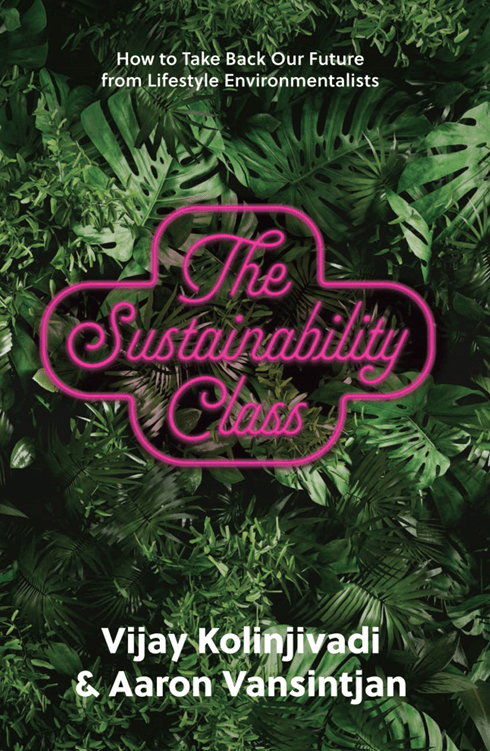
In The Sustainability Class, Aaron Vansintjan and Vijay Kolinjivadi explore the forces behind this state of affairs. They argue that environmental responsibility has been commodified, and transformed into a consumer-driven status symbol that serves the interests of an affluent elite. Sustainability has become less about systemic change and more about distinction – an aesthetic and moral badge of honour worn by those who can afford it, leveraging green consumerism and other hallmarks of green living as both a sincere response to environmental concerns and a marker of social status.
Yet the solutions they champion frequently replicate the very systems they seek to reform. Resource extraction for green technologies devastates communities in mineral-rich regions, while waste from rich nations finds its way to the landfills and waterways of the world’s poorest regions. Green capitalism thus functions as a sleight of hand: maintaining existing hierarchies while projecting an illusion of progress, allowing the sustainability class to maintain their privileges under the guise of environmental stewardship.
The working class and other marginalised communities, often the first to feel the effects of ecological harm, are meanwhile excluded from environmental policymaking. Instead, they are frequently portrayed as obstacles to progress, their immediate needs conflicting with the distant priorities of eco-elites. The dynamics of green gentrification, where exclusive eco-development causes low-income residents to be displaced by rising housing costs, and public spaces get rebranded as luxury amenities for the well-to-do, illustrate how environmental policies are often imposed without consideration for those who must bear their burdens. This exclusion breeds resentment, which is then exploited by populist movements framing environmentalism as a privileged agenda.
The emphasis on individual consumption further compounds the problem. The popular fixation on personal responsibility – whether in the form of zero-waste lifestyles, ethical shopping, or dietary purity, obscures the role of corporations and governments in perpetuating ecological destruction and alienates those who lack the resources to participate. The result is a form of environmental classism that undermines collective solutions.
The core failure of the solutions proposed by the sustainability class lies in their refusal to confront capitalism as the root cause of the crisis. The book argues that the ecological crisis is not an unintended consequence of industrialisation, but a direct result of capitalism’s relentless pursuit of growth and profit. This is a system that thrives on the over-extraction of resources, the exploitation of labour, and the externalisation of environmental costs – particularly onto the Global South. As long as it remains unchallenged, sustainability will remain a hollow slogan.
Consider carbon offsetting, one the crown jewels of green capitalism. Framed as a way for corporations and wealthy nations to ‘neutralise’ their emissions, offsetting often shifts the burden of climate responsibility onto poorer regions. But these projects often displace local communities (sometimes by force) and degrade ecosystems. Worse, the accounting is dubious: forests that were never at risk are declared ‘saved,’ and trees that fail to survive render entire offsets meaningless, turning promised carbon sinks into barren landscapes. Carbon offsetting will never achieve its goal because it is a financial instrument first, and an environmental solution second. The logic of speculation ensures that credits are bought and sold in a volatile marketplace where actual emissions reductions become secondary to profit-making.
This extends to the broader framework of ‘natural capital’ and ‘ecosystem services’, which attempt to assign monetary value to nature. In doing so, these mechanisms do not safeguard biodiversity or climate stability but transform the natural world into an asset class for investors. By treating entire ecosystems as commodities, green financiers legitimise their continued destruction under the guise of ‘internalising the externalities’. What emerges is not ecological protection, but a bubble built on the illusion that markets can correct the very crisis they have created.
The authors trace this way of thinking to a worldview that treats nature as separate from humanity – an external entity to be managed, exploited, or conserved, rather than as an interconnected system of which humans are a part. Modern environmentalism often focuses on conservation and restoration without addressing the systemic drivers of degradation. In reality, ecological harm cannot be separated from the social and economic systems that produce it.
Vansintjan and Kolinjivadi ultimately argue that a genuine ecological transition cannot be imposed from the top down, where policy is often shaped by elite interests. Instead, they advocate for a coalition of movements uniting environmentalism with struggles against economic and social injustice. This coalition must bridge the divide between the sustainability class and the dispossessed. Workers displaced by industrial transitions, communities affected by pollution, and those marginalised by the system must be included in the conversation.
If the members of this class are to be more than a green aristocracy, they must relinquish their grip on the environmental narrative. This means moving beyond piecemeal reforms and individual heroics, and embracing a radical politics that places justice at the center of ecological action. Sustainability should not be about ‘greening’ capitalism but about fundamentally reimagining our relationship with the planet and each other. It should not be about a select few securing their futures in walled-off green enclaves, but about ensuring a liveable world for all.
 The WCCA